I recently got my American O1 visa. On the plane to San Francisco, I was pondering.
There's such a massive gap between even the most innovative places in Europe or Asia and the best places in the US. My home Vienna isn't even close to San Francisco.
This is obvious to the ones who made it to this side of the pond. But this is not at all obvious to the rest of the world.
It's easy to roast America for all of its very real misgivings, which you can read plenty about in the news. But few are emphasizing the importance of legal, high-skilled immigration. Especially to talented people around the world. As I didn't find many great write-ups to share with growth-hungry friends in Europe and Asia, I've been collecting a few notes and thoughts.
So here's some quick, raw, and obvious observations on America, from a European who moved here 4 years ago.
- Stay in Europe if you want to grow linearly. Go to America if you want to grow exponentially.
- I noticed a widening gap between friends who find excuses to stay, and the ones who pack their suitcase and take a leap of faith.
- The gap widens every year and it compounds. Taking the leap at age 20 often leads to noticeable compounding differences than at 25. Taking the leap at 25 is still a greater time than at age 30--if you take the leap then at all.
- 14% of the US population is foreign-born.[1] Yet, 55% of US billion-dollar companies have immigrant cofounders.[2]
- Google was cofounded by a Russian PhD student.
- The iPhone was designed by the son of a Syrian immigrant.
- NVIDIA was founded by a Taiwanese electrical engineer.
- The CEO of Intel fled Soviet tanks in Budapest.
- One of the most luminary investors in the Bay came from Delhi.
- In the US there's been a lot of discussion making the case of skilled immigration for the US. But few people have made the case to the skilled yet-immigrants.
- Win-Win, Skilled immigration is absolutely mission-critical to America
- Skilled legal immigration is crucial for national security. The Manhattan Project and Apollo Project, leading to American nuclear and rocketry dominance, was built on the shoulders of immigrants (Teller, Oppenheimer, von Neumann, Braun, ...)
- Talent we fail to retain in the country will go elsewhere. This is especially true for Chinese talent: To stay ahead of China, the USA will need to fight for talented Chinese to stay.
- Many talented PhD friends from MIT are considering going back to China or already did so--they're smart, obsessed researchers loving their research. With byzantine and discriminatory visa policies, we're pushing them back into the hands of China.
- CBO estimates that immigrants will add $7 trillion to the US economy in the upcoming decade.[4]
- Skilled immigrants file patents at 2x the rate of native-born Americans, benefitting everyone.[5]
- "Go west, young man" -- Horace Greeley
- By default, friends who stay in Europe stagnate--like their economy. By default, friends who come to the US do well.
- Build a small community in the Bay or Boston, and you'll be constantly bombarded by interesting ideas, great job opportunities, and intriguing friends.
- There's still luck involved. Yet, it's easier to be lucky in America.
- Unlike China or Germany, the US is a country of immigrants. Almost everyone's family came here less than 8 generations ago.
- Though the US forgets this every few years.
- You become a true American in a few years after moving. You'll never become a true German in your lifetime if you move to Germany. h/t Alexey Guzey--a Russian-American.
- Spruce (British-American) on San Francisco: "When you live in essentially a year-round paradise, isolated on all sides by desert, sea and bad weather, Maslow's needs fill up and you become more concerned with changing the world."[6]
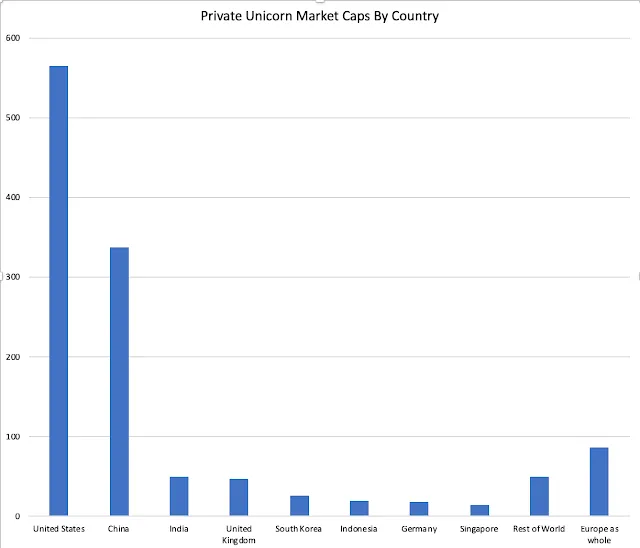
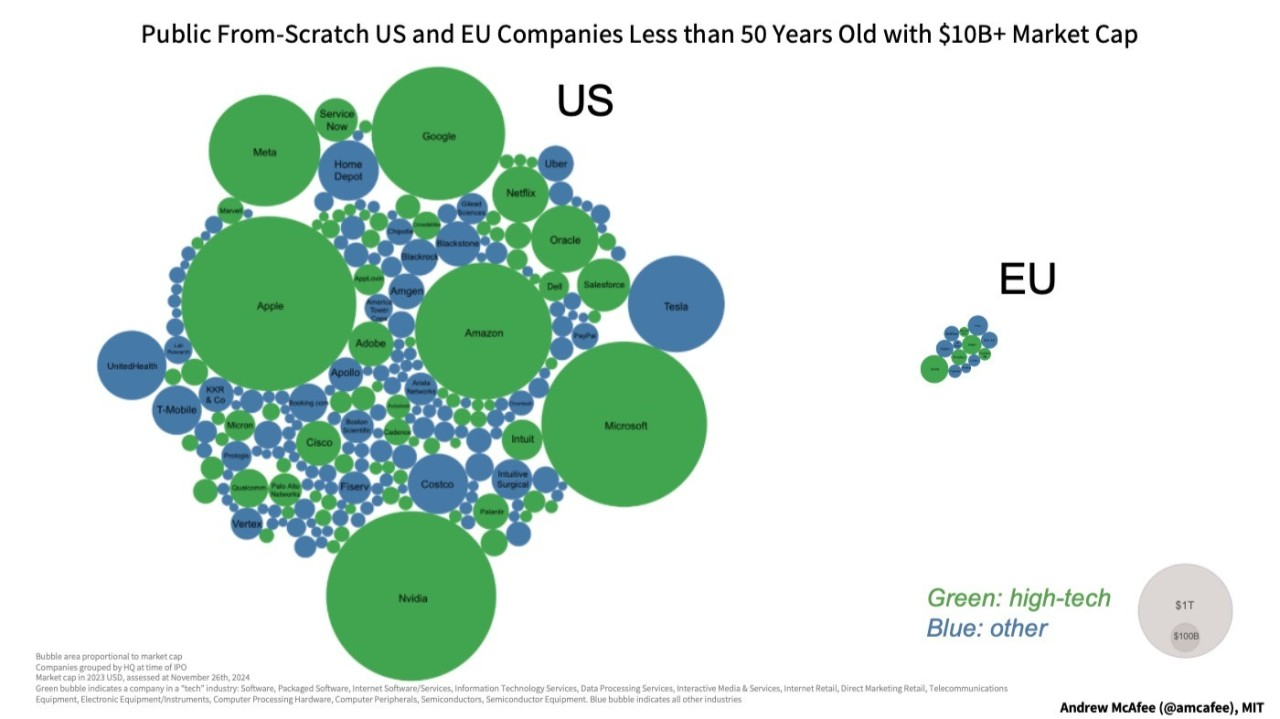
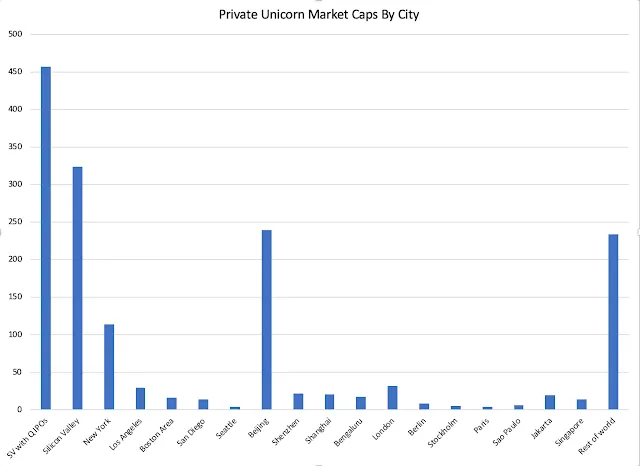
- US company infrastructure is built different. One of the most insane visualizations of this: deca-unicorns from scratch.[9]
- In response: "Europe is a museum as a continent and a museum as a stock market". h/t Delian Asparouhov (Bulgarian-American)
- It's daily routine for 20-year-olds to start multimillion-dollar companies in San Francisco.
- This one is so obvious to folks here that it's not appreciated enough. Yet this is inconceivable in much of the outside world!
- This nearly never happens in my European circles.
- This happens all the time in my US circles.
- Sigil. Vincent. Anna. Max. Viraj. Johannes. Julius. Lada. Moritz. Moritz. Minn. Sacha. Aydin. Anne, Raeez. Ananya. Zeel, Michael, Michael. And many more. ...
- This extends to employees at companies: When Google went public, the first employee of the massage team had stock options worth $5 million.
- The US is one of the few places that believes in young people being able to make a positive dent in the world.
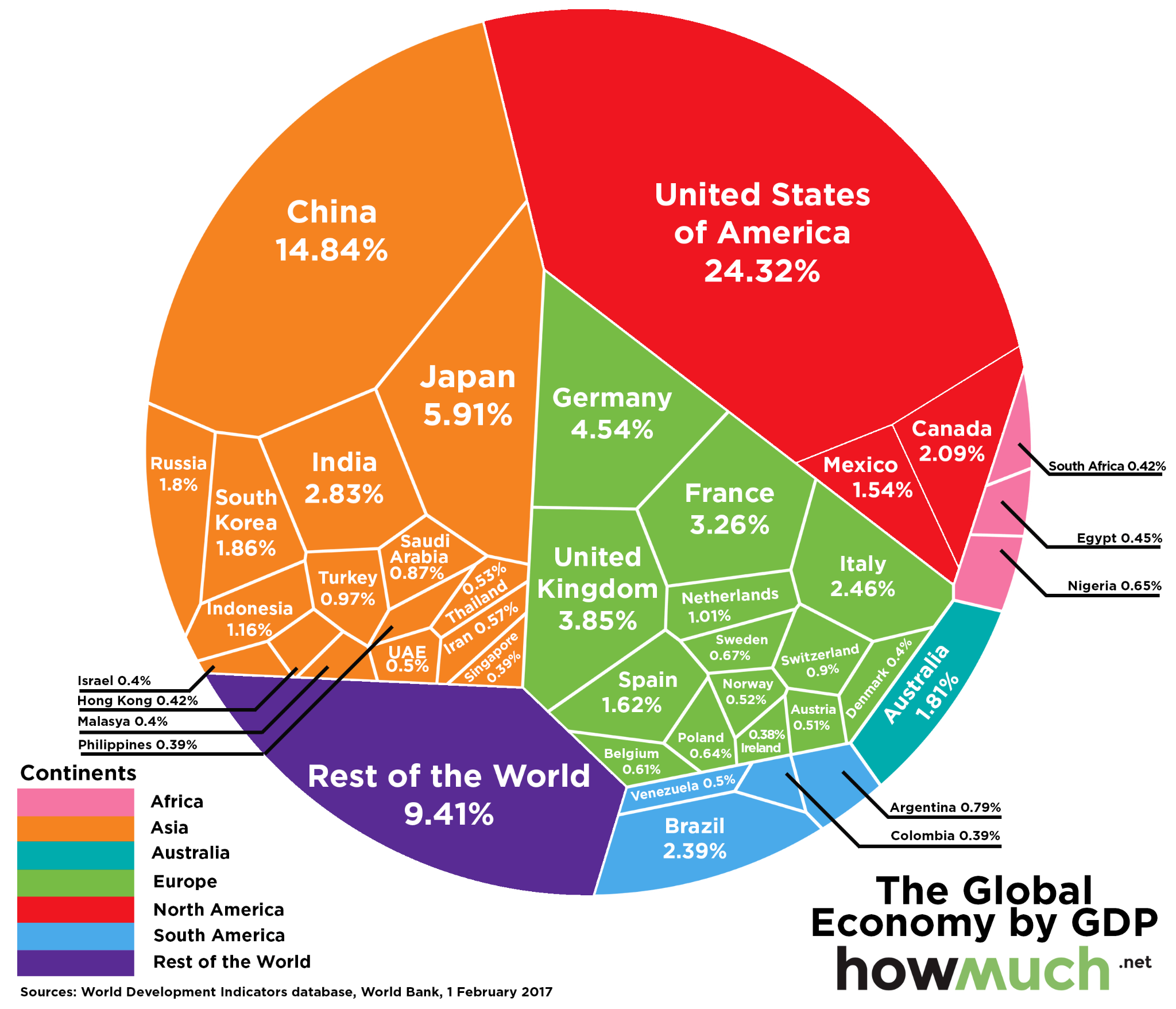
- The US remains an absolute economic and innovation powerhouse. The US economy is ~$29 trillion (2024), roughly 26% of world GDP -- larger than the entire EU ($19.4T) or China ($18.7T) individually.[10]
- I noticed people often mistakenly compare the average person in America vs Europe or Asia. The average is horrible! Overweight, diabetic, stuck in a small dying city. America is about the top extreme, about the 99th percentile, about there being no ceiling, about the exceptions. American exceptionalism.
- Jannik Schilling (German-American): "Why do young ambitious individuals decide to move from a relatively wealthy country like Germany to the United States?"[11]
- I noticed even within the US, people usually underappreciate the gap between the very best places and the next-best places. San Francisco isn't just a bit better than Boston for start-ups: It's many multiples better than Boston. New York isn't just a bit better for working in finance than San Francisco, it's drastically better.
- People move to San Francisco and usually become more innovative and ambitious. I rarely see someone move to New York and then do more innovative or ambitious work.
- It's hard to have an intuitive feeling for power laws.
- This holds true for scientific research. Sam Rodriques: "European science faces some extraordinary headwinds, which are hard to overcome. The general lack of funding has been well-documented, and the red tape is indeed far beyond anything that American academics have to deal with. But the primary challenge is cultural, and is both far less visible and far more pernicious."[12]
- The San Francisco Bay Area is the impact capital of the world.
- Driving a disproportionate amount of technological progress (computers, laptops, smartphones, self-driving cars, software)
- Driving a disproportionate amount of cultural change (60s hippies culture, environmentalism, etc)
- The San Francisco Bay Area is the start-up capital of the world. Within the US, a power-lawed distribution holds as well: A few large cities attract the vast majority of talent, funding, and culture, leading to them consistently being the very best breeding ground for spectacular successes.
- The Bay Area alone captured some $70B of the $135B global AI venture investment in 2024.[13]
- Patrick Collison (Irish-American): Figure out a way to travel to San Francisco and to meet other people who've moved there to pursue their dreams. Why San Francisco? San Francisco is the Schelling point for high-openness, smart, energetic, optimistic people. Global Weird HQ. Take advantage of opportunities to travel to other places too, of course.[15]
- High-skilled legal immigration is a hardcore selection filter. This makes internationals tend to be higher-openness, smarter, hard-working, and resourceful.
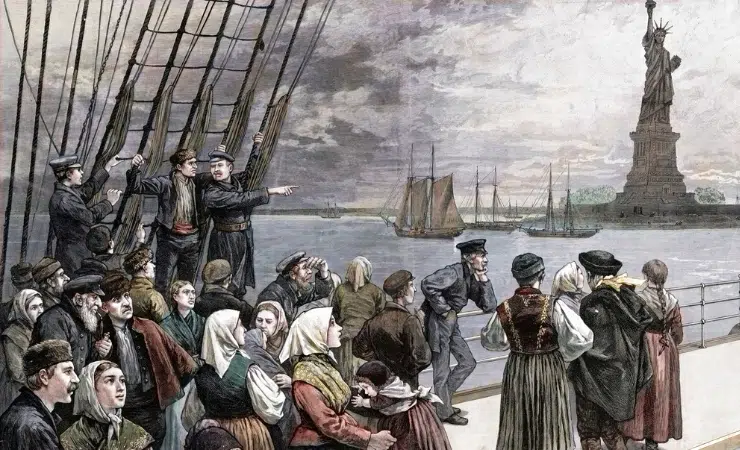
- This is true of yesterday's American founders crusading across the Atlantic--it takes craziness to leave everything behind and embark on a one-way multi-month ship ride to a NEW country.
- This is true of today's high-skilled immigrants, who have to navigate a byzantine maze of ESTA J1 F1 O1 H1B visas. It takes genuine resourcefulness, agency, and willpower to legally immigrate to America. And like in the old days, they still have to leave family & friends behind.
- The immigration filters (ambition, outliers, openness to new things) might be directly causal of today's high-variance in the USA: One of my favorite thoughts I've read about this is that the American founding pioneers tended to be oddballs, religiously persecuted (eg Amish), or just wildly ambitious. That kind of preselection led to both cultural and genetic evolutionary pressure: There's literally dopamine receptor variants associated with risk-taking that are much more common in Americans descended from the early Europeans.[16]Chen et al. (1999) in Evolution and Human Behavior found populations that migrated farther from ancestral origins have higher frequencies of the DRD4 7R allele (r = 0.85, p < .001).
- In Europe, having failed is a stain on your CV. In America, having failed is a badge of honor.
- You're allowed to fail on your high-upside bets. In the US, you can blow up a start-up at age 28, take your lessons from it, and credibly try again at age 30.
- Consider Sam Altman, who at age 19 co-founded Loopt,[17] a location-sharing app in Y Combinator's first batch,[18] that ended up doing okay but not becoming a massive hit. After "failing" that start-up, he then became the president of one of the biggest up-and-coming tech investing funds of San Francisco. After that, he started one of the most important companies of the century. Irrespective of what you think of the work, this is an impressive outcome for just doing "so-so" on your first big bet. In Europe or Asia, Sam would've struggled to raise or build a team after his first project.
- Steve Jobs was fired from his own company at age 30. Founded NeXT (commercially unsuccessful). Apple acquired NeXT in 1997, bringing Jobs back. He then led Apple to become the most valuable company on Earth.
- Even bankruptcy is reasonably fine: Personal bankruptcy seems surprisingly survivable in the US. You can just re-start after. That's wild!
- San Francisco is relentlessly sunny. That instills a relentlessly sunny optimism.
"The climate of San Francisco is mild and singularly equable. The thermometer stands at about seventy degrees the year round. ... It is as pleasant a climate as could well be contrived" -- Mark Twain
- Everyone is a little crazy in America, so people make high upside bets.
- Investors make high-upside bets.
- When we were fundraising, US investors were willing to seriously listen to our most far-out ambitions. The European investors we talked to often hit their ceiling of what they were able to imagine. (We exceeded their wildest imagination in less than 6 months.)
- Global VC in 2024: $368B total.[14] US: ~$209B (57%). Europe: ~$62B (17%). Asia-Pacific: ~$79B (21%). The US alone invested more than 3x Europe.
- Private philanthropy makes high-upside bets.
- Look at Bill Gates and Dustin Moskovitz making money in the private sector, and then donating it away at a massive scale. Kudos. The Gates Foundation has helped save an estimated 122 million lives.[19] Moskovitz and Tuna are giving away $20B.[20]
- US total philanthropy in 2024: Ca $600B.[21]US: $592.5B (2.1% GDP). UK: ~$19.5B (0.5% GDP). Germany: ~$24B (0.5% GDP). Japan: ~$8.7B (0.2% GDP). The US gives 25-30x more than any peer nation.
- Even the government makes high-upside bets.
- DARPA took impressive bets that enabled the modern internet and mRNA vaccines.[22]
- The Department of Defense enabling GPS.
- ARPA-H.
- The UK is explicitly trying to import this model of high-upside gov innovation. But my impression is the young British ARIA already trends less ambitious than the 68-year-old DARPA.
- Does this shine a Straussian light on the founding CEO saying "Stay bold, ARIA" while leaving back to the US?[23]
- DARPA just committed $35M to fund "smart red blood cells capable of sensing extracellular biomarkers, making autonomous decisions"[24] to "maximize human performance and survivability"[25]
- Investors make high-upside bets.
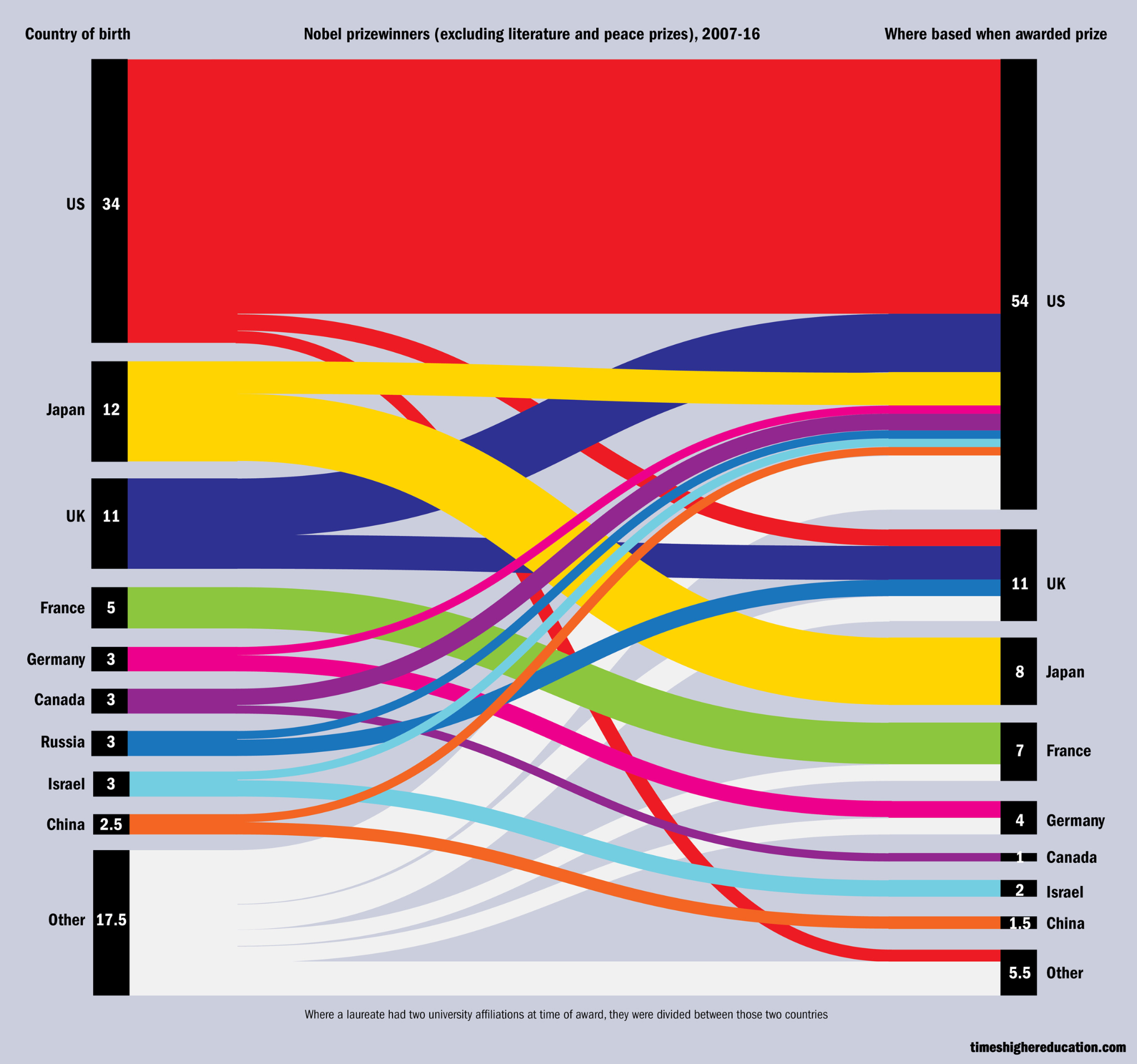
- Most Nobel Prize winners are from the US or end up in the US.[26]
- This is despite the fact that the US is a fairly young country.
- America is weird. America is extreme. America is high-variance.
- Extreme cities: Towering city cores in a single-family home landscape.
- Extreme wealth: Taking a Waymo self-driving car through the piss-stained heartbreaking homeless camps of Tenderloin.
- Extreme delulu: delulu schizoid conspiracy theorists, extreme delulu brilliant Nobel laureates. (Surprisingly often the same person?)
- Extreme politics: The political spectrum seems more extreme than most countries, with furious culture wars and election wars ravaging the country every few years.
- Importantly, this high variance also means that the high-end is exceptional. The richest are absurdly rich. The most inventive are spectacularly creative. The most impactful are exceptionally impactful.
- America is exceptional.
Does anybody really doubt that California is the most interesting place on earth? -- Asterisk[27]
- Last summer I landed in Berlin and took a clean, functioning electric train passing past the high-density skyline. I cried. I do miss Europe. Of course I still love you.
- Taking a leap of faith is a sacrifice that I don't see people often sharing: Seeing your family at most once every few years or so. Leaving friends behind. Trading off quality of life to pursue the work that matters the most to you.
- America is serious about working hard. China is serious about working hard (996).[28] Europe forbids working hard.
- Literally forbidden: When I was in Vienna over Christmas trying to finish a project on a weekend, literally most cafes forbid laptops.
- A friend of mine was working at a French startup. When she finished and pushed some code on a Saturday at 2 AM, her supervisor told her the next day that she's "not allowed to do that".
- It's also actively uncool to work hard in Europe. Many Europeans reading this might be thinking to themselves "So slave away your life then".
- Average annual hours worked (OECD 2023[29]): USA 1,796. France 1,500. Netherlands 1,420. Germany 1,340. Germans work ~27% fewer hours -- that's 11 extra 40-hour weeks Americans work per year.
- Of course there's exceptions. Yet this is closer to the norm than the hardworking cultural currents feeding America or Asia.
- "You go to Europe if you want to eat pasta, drink wine, and have fun, you go to America if you want to pursue your dreams and challenge yourself."
- The US freely allows anyone to hold other citizenships. This is not at all the norm! Many countries make you "choose" between citizenships or at least put you through a maze of paperwork. But you can be American and German. American and Japanese. American and.
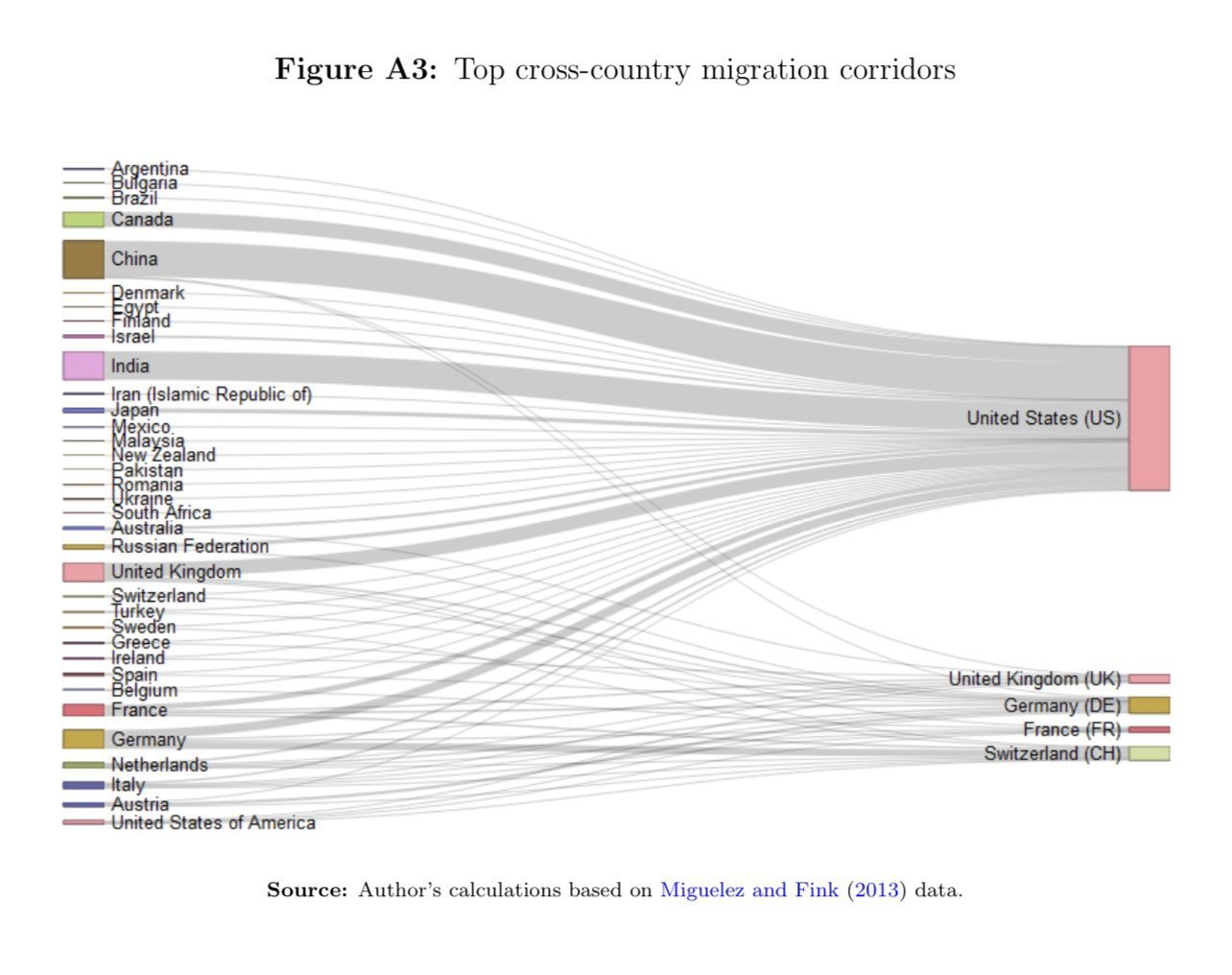
- The US is the single-largest talent magnet on Earth.
- The United States of America is like 50 small and different countries all deciding to work together on an epic goal.
- Within one country, that gives you an unprecedented amount of diversity of climates, nature, culture and beauty to explore.
- Within one country, that gives diversity in taxation, housing, schooling, and other policy experiments. America is a natural breeding ground for state-wide policy experiments.
- You can pay 14% income tax in California or 0% in Texas.
- Montana's "Right To Try"[30] allows many patients to access any drug that has passed Phase I clinical trials but isn't approved.
- Carrying a gun in New Jersey requires rigorous training and evaluation; carrying a gun in Texas requires a walk to the gun store.
- You can legally buy cannabis in a sleek Apple-like store in New Mexico; if you drive over the border to Texas this is now a criminal offense.
- For four years, Oregon decided in Measure 110[31] that they wouldn't punish possession of nearly any drug. (That state-wide experiment stopped in 2024.)
- In Alaska, there is a law forbidding pushing a live moose out of a plane. Alabama forbade you from playing dominoes on Sundays until 2015. In Alaska, kangaroos are forbidden from entering a barber shop.
- Berlin is uniquely good at taking ambitious people and converting them to hippies. Refrain and run before the acid and acid techno will take your 20s.
-
"In America there was also a kind of spirit, a drive that was meant to match the breadth of the continent. Freewheeling, gutsy, starry-eyed former farm boys and urban urchins concocted visions and promoted schemes so large that men of smaller enclaves like England, France, and Germany blanched when hearing them. [...] Americans burned with frontier zeal to leave yesterday's methods in the dust on a dash for the new and improved." -- Brooke C. Stoddard, Steel: From Mine to Mill, the Metal that Made America (h/t Jason Crawford)
- Friends moving from Europe to the US become much more agentic -- they get more things done, and manifest their ideas faster.
- One metric: Their text/email response speed accelerates, often from days to minutes.
- Environment shapes entire personalities: One talented friend was depressed and unable to work on anything of interest in her environment in Munich. I asked her if she trusts me and is willing to take a leap of faith -- a few weeks later she was deep in San Francisco. Within a week in San Francisco, she had a job offer, made new friends that lifted her up, and started flourishing.
- She said "In San Francisco macht es keinen Sinn ein trauriger Sack zu sein" -- "It doesn't make sense to be sad in San Francisco"
- Europe needs to get its act together.
- Paul Graham (British-American): "The Bay Area was a magnet for the young and optimistic for decades before it was associated with technology. It was a place people went in search of something new. And so it became synonymous with California nuttiness. There's still a lot of that there. [...] Most good startup ideas seem a little crazy; if they were obviously good ideas, someone would have done them already."[32]
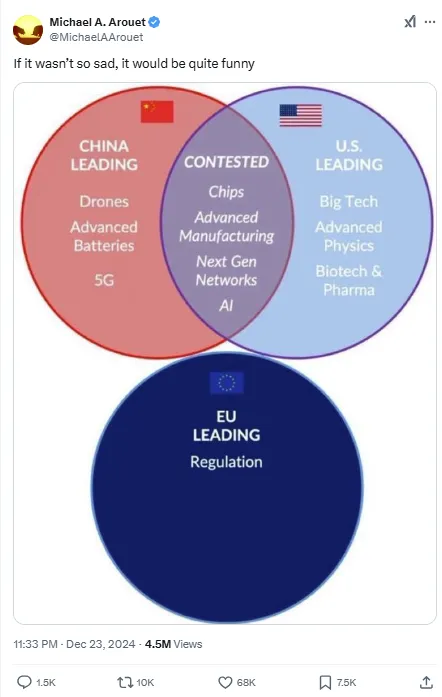
- The future happens first in America.
The future happens at scale in Asia.
The future gets regulated in Europe. - I see a lot of smart people in Europe coping with a vague imitation of start-ups, being happy with small government grants, and priding themselves in the dimming embers of European greatness.
- Noah Smith: Eurocope[3]
- This is similarly true for friends pursuing a PhD, not realizing that the research they could be doing could be much further at the frontier.
- It takes a lot of raw self-honesty to admit to oneself "The place I was born is probabilistically unlikely to be the best place for me to do my best work" and to go search for the very best place.
- Scott Alexander: A lot of what I love about California is downstream of its geography as the westernmost part of the western world - the people who felt confined by Europe fled to America, and the people who felt confined by America fled to California, and until recently it was an open space big enough for new experiments to grow.[33]
- I believe that many people are capable of greatness. Yet, if you're going to climb Mount Everest, you better have the very best equipment and sherpas on the way.
- God bless America.
Writing is mine. Review and fact-checking was done with Opus-4.5 and GPT-5.2. All mistakes are mine. Corrections and thoughts are welcome at i@isaak.net.
Various notes and readings of interest
- Jason Hausenloy: Move to America
- Jason Hausenloy: Rambling on SF
- Asterisk Magazine Editorial
- Sam Rodriques: Europe
- Andreas Klinger: EU-ACC
- Delian Asparouhov on Twenty Minute VC
- Paul Graham: Cities
- Janelle Teng: American vs European Startup Dynamism
- Noah Smith: Skilled Immigration Is a National Security Issue
- Graham's America, Founder Visa, The Submarine, Startup Hubs
Sources
- US Census Bureau: Foreign-Born Population (2024) ↩
- NFAP: Immigrant Entrepreneurs and US Billion-Dollar Companies ↩
- Noah Smith: Eurocope ↩
- Congressional Budget Office ↩
- NBER: Immigrant Patent Rates ↩
- Spruce: Grand Unified Theory of SF ↩
- Abramitzky, Boustan & Jacome (NBER/AER) ↩
- Time: 100+ Years of Immigrant Mobility Data ↩
- Andrew McAfee: US v EU in Tech ↩
- IMF via Visual Capitalist ↩
- Jannik Schilling: Passing Thoughts on Leaving Germany ↩
- Sam Rodriques: Europe ↩
- PitchBook: SF Bay Area AI Venture Investment ↩
- KPMG Venture Pulse: Global VC 2024 ↩
- Patrick Collison: Advice ↩
- Chen et al. (1999): DRD4 7R Allele and Migration ↩
- Wikipedia: Loopt ↩
- TechCrunch: Y Combinator's First Batch ↩
- The Gates Foundation: 122 Million Lives Saved ↩
- Fortune: Moskovitz and Tuna $20B Pledge ↩
- Giving USA 2025: $592.5B in Charitable Giving ↩
- Washington Post: DARPA and mRNA Vaccines ↩
- Sifted: ARIA CEO Ilan Gur Leaves UK ↩
- DARPA: Smart-RBC Program ↩
- Science: Smart Blood Cells for Military ↩
- Times Higher Education: Nobel Prize Winners ↩
- Asterisk Magazine Editorial ↩
- Wikipedia: 996 Working Hour System ↩
- OECD: Hours Worked (2023) ↩
- Wikipedia: Right-to-Try Law ↩
- Wikipedia: Oregon Measure 110 ↩
- Paul Graham: Cities and Ambition ↩
- Scott Alexander: Model City Monday ↩